
Introduction
As digital transformation accelerates across the Middle East, organizations require network infrastructures that are secure, scalable, and capable of delivering high performance across multiple locations and countries. Enterprises, telecom operators, financial institutions, and cloud providers all face the challenge of connecting distributed offices, data centers, and cloud environments while maintaining reliability and low latency.
One of the most widely adopted technologies addressing these challenges is Multiprotocol Label Switching (MPLS). Across the region, MPLS networks in the Middle East have become the backbone of enterprise connectivity, enabling secure data transmission, efficient traffic management, and predictable network performance.
Companies operating in markets such as the UAE, Turkey, Iraq, and Iran increasingly rely on MPLS infrastructure to support mission‑critical applications, cloud platforms, and cross‑border connectivity. With the growth of regional digital ecosystems, the demand for enterprise MPLS solutions in the Middle East continues to expand.
This article explores the architecture of MPLS networks, the key technology benefits, and real enterprise use cases, while also highlighting how next‑generation MPLS networks are evolving to support modern business requirements.
What is MPLS?
Multiprotocol Label Switching (MPLS) is a high‑performance network routing technology that directs data between nodes using short path labels instead of complex routing table lookups. These labels allow routers to make faster forwarding decisions, significantly improving the speed and efficiency of network traffic management.
Unlike traditional IP routing, which examines packet headers at every hop, MPLS assigns labels to packets at the network edge. Once a packet enters the MPLS network, it follows a predetermined path called a Label Switched Path (LSP).
This architecture enables:
• Faster packet forwarding
• Efficient traffic engineering
• Improved Quality of Service (QoS)
• Predictable latency and performance
For organizations operating across multiple countries in the Middle East, MPLS provides a reliable way to connect remote branches, regional offices, and data centers.
Why MPLS is Important for the Middle East
The Middle East is experiencing rapid growth in digital infrastructure. Enterprises are expanding regionally, telecom operators are modernizing networks, and cloud adoption continues to accelerate.
However, the region also presents networking challenges:
• Long‑distance connectivity across countries
• Cross‑border network latency
• Security requirements for enterprise data
• Integration with cloud platforms and data centers
To address these challenges, many organizations deploy MPLS network solutions in the Middle East to build secure private networks between their locations.
MPLS enables companies to maintain consistent network performance even when connecting multiple countries such as:
• United Arab Emirates
• Turkey
• Iraq
• Iran
• GCC countries
• broader MENA region
With MPLS, businesses can ensure stable connectivity between headquarters, regional branches, and cloud environments.
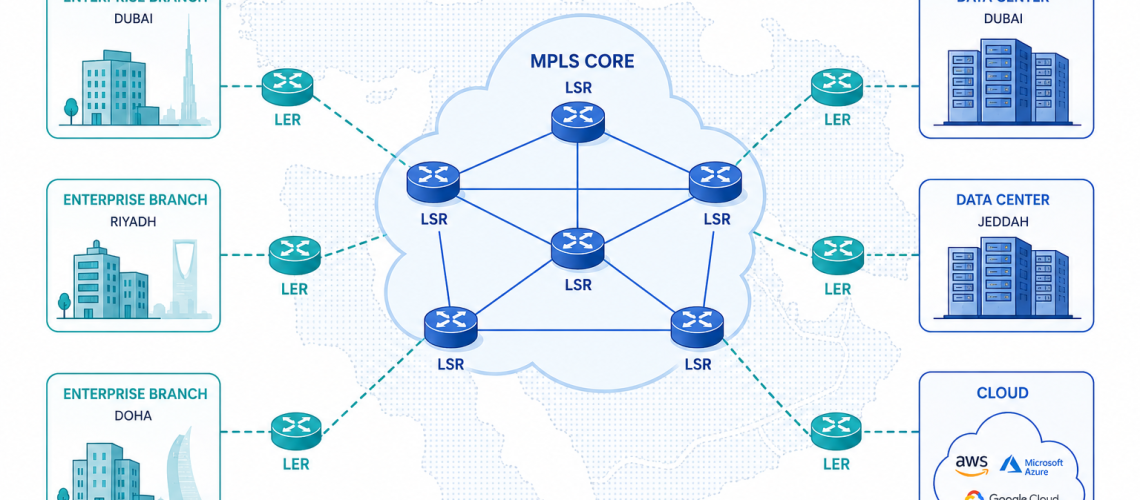
MPLS Network Architecture
Understanding the architecture of MPLS helps explain why it is so effective for enterprise networking.
Label Edge Routers (LER)
Label Edge Routers sit at the entry and exit points of an MPLS network. These routers assign labels to incoming packets and remove them when packets leave the MPLS domain.
They perform tasks such as:
• Packet classification
• Label assignment
• Traffic prioritization
Label Switching Routers (LSR)
Inside the MPLS core network, Label Switching Routers forward packets based on their labels. These routers do not inspect the full IP header, which makes packet forwarding significantly faster.
Label Switched Paths (LSP)
Packets travel across the MPLS network using predefined routes called Label Switched Paths. These paths are optimized for performance, reliability, and network efficiency.
Traffic Engineering
MPLS supports advanced traffic engineering, allowing network operators to direct traffic along optimal routes and avoid congestion. This ensures critical applications receive the bandwidth and performance they require.
Key MPLS Technology Benefits
Organizations adopt MPLS because it offers several technical advantages over traditional networking approaches.
High Performance and Low Latency
One of the most significant MPLS technology benefits in the Middle East is improved network performance. Because MPLS uses labels instead of complex routing lookups, packets move through the network faster and more efficiently.
This results in:
• Reduced latency
• Faster data transmission
• Improved application performance
For industries such as finance, telecom, and cloud services, low latency is essential.
Secure Private Networking
MPLS networks provide secure connectivity by operating as private networks separate from the public internet. This architecture protects sensitive enterprise data while enabling communication between multiple locations.
Businesses operating across the region often deploy secure MPLS networks in the Middle East to connect offices and data centers safely.
Quality of Service (QoS)
Another major advantage of MPLS is built‑in support for Quality of Service.
QoS allows network administrators to prioritize different types of traffic, such as:
• voice communications
• video conferencing
• enterprise applications
• cloud services
This ensures that critical business applications receive the bandwidth and performance they need.
Scalability for Enterprise Growth
As organizations expand across the Middle East, their networks must scale accordingly. MPLS networks provide flexible infrastructure that can support growing numbers of branches, users, and services.
This makes MPLS ideal for enterprise MPLS solutions in the Middle East, particularly for companies operating across multiple countries.
Multi‑Site Connectivity
Many enterprises operate across several regional offices and require reliable connectivity between them. MPLS allows organizations to build multi‑site networks that connect offices, data centers, and cloud environments seamlessly.
This capability is particularly useful for businesses operating in multiple markets such as the UAE, Turkey, Iraq, and Iran.
Enterprise MPLS Use Cases
MPLS technology supports a wide range of enterprise networking applications.
Multi‑Branch Enterprise Connectivity
Large enterprises often operate dozens of offices across multiple cities or countries. MPLS allows these organizations to build a private wide‑area network connecting all locations.
This architecture supports:
• centralized applications
• secure internal communication
• efficient data sharing
Companies looking to deploy this type of infrastructure often implement enterprise MPLS connectivity solutions across the Middle East.
Telecom Operator Networks
Telecommunications providers rely heavily on MPLS to manage large‑scale carrier networks.
MPLS helps telecom operators deliver services such as:
• mobile backhaul
• internet transit
• enterprise connectivity
• roaming infrastructure
Modern telecom infrastructures across the region increasingly depend on next‑generation MPLS networks in the Middle East to support high traffic volumes and growing data demand.
Data Center Interconnect
Organizations operating multiple data centers require reliable connectivity between them. MPLS enables high‑capacity, low‑latency connections between data centers located in different cities or countries.
For example, companies may connect data centers across:
• Dubai
• Istanbul
• Baghdad
• Tehran
This type of architecture ensures high availability and redundancy for critical systems.
Cloud Integration
As cloud adoption grows, enterprises require secure connections between on‑premise infrastructure and cloud platforms.
MPLS networks can be integrated with private or hybrid cloud architectures, enabling businesses to maintain consistent network performance while accessing cloud resources.
Solutions such as Z‑Cloud infrastructure services help organizations combine cloud platforms with high‑performance MPLS connectivity.
MPLS and Cross‑Border Connectivity
Businesses operating across the Middle East frequently require cross‑border connectivity between multiple countries. Traditional internet‑based connectivity can introduce latency, security concerns, and inconsistent performance.
MPLS provides a more stable alternative for regional network connectivity.
Companies deploying MPLS across the region can create private network paths between countries such as:
• UAE
• Turkey
• Iraq
• Iran
This enables secure communication between branches while maintaining predictable network performance.
Organizations implementing cross‑border infrastructure often rely on solutions such as Z‑Connect enterprise connectivity platforms to establish secure MPLS connectivity between multiple markets.
The Future of Next‑Generation MPLS Networks
While newer technologies such as SD‑WAN are emerging, MPLS remains a critical component of modern enterprise networks. In many cases, MPLS and SD‑WAN are deployed together as hybrid networking solutions.
Future next‑generation MPLS networks in the Middle East are expected to include:
• integration with SD‑WAN architectures
• enhanced network automation
• AI‑driven traffic optimization
• deeper integration with cloud infrastructure
• improved network monitoring platforms
Advanced monitoring platforms such as network service quality management systems help telecom operators analyze network performance, detect anomalies, and ensure service quality across complex MPLS environments.
Similarly, telecom providers may integrate roaming quality monitoring platforms and revenue assurance and fraud management systems to maintain operational integrity across large regional networks.
Conclusion
As digital infrastructure continues to expand across the region, MPLS remains one of the most reliable technologies for enterprise connectivity. Businesses require networks that are secure, scalable, and capable of delivering consistent performance across multiple countries.
MPLS networks in the Middle East provide these capabilities by enabling fast packet forwarding, advanced traffic engineering, and reliable private connectivity between distributed locations.
From telecom operators and financial institutions to multinational enterprises and cloud providers, organizations rely on enterprise MPLS solutions in the Middle East to support mission‑critical applications and cross‑border operations.
As technology evolves, next‑generation MPLS networks will continue to play a vital role in enabling digital transformation across the Middle East, helping businesses build resilient, high‑performance network infrastructures for the future.
For organizations seeking scalable connectivity solutions across the region, integrating MPLS with platforms such as Z‑Connect, Z‑Cloud, and advanced network monitoring systems can provide the foundation for secure and high‑performance enterprise networking.
